Enhancing Food Court Experience Through Design Thinking
DOI:
https://doi.org/10.34148/teknika.v15i1.1452Keywords:
Customer Experience, Design Thinking, Digital Ordering Systems, Mall Food Court, UX/UI DesignAbstract
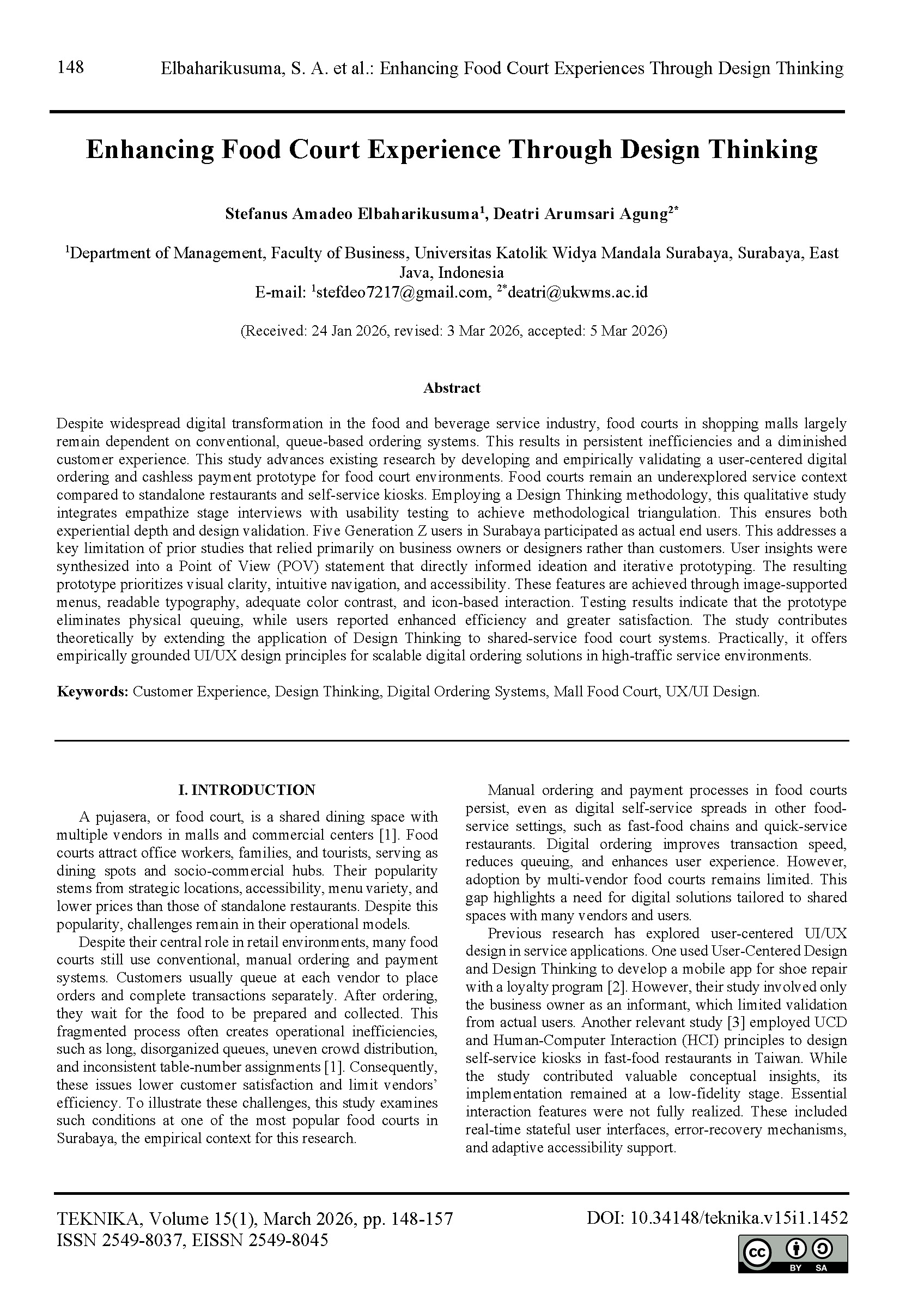
Despite widespread digital transformation in the food and beverage service industry, food courts in shopping malls largely remain dependent on conventional, queue-based ordering systems. This results in persistent inefficiencies and a diminished customer experience. This study advances existing research by developing and empirically validating a user-centered digital ordering and cashless payment prototype for food court environments. Food courts remain an underexplored service context compared to standalone restaurants and self-service kiosks. Employing a Design Thinking methodology, this qualitative study integrates empathize stage interviews with usability testing to achieve methodological triangulation. This ensures both experiential depth and design validation. Five Generation Z users in Surabaya participated as actual end users. This addresses a key limitation of prior studies that relied primarily on business owners or designers rather than customers. User insights were synthesized into a Point of View (POV) statement that directly informed ideation and iterative prototyping. The resulting prototype prioritizes visual clarity, intuitive navigation, and accessibility. These features are achieved through image-supported menus, readable typography, adequate color contrast, and icon-based interaction. Testing results indicate that the prototype eliminates physical queuing, while users reported enhanced efficiency and greater satisfaction. The study contributes theoretically by extending the application of Design Thinking to shared-service food court systems. Practically, it offers empirically grounded UI/UX design principles for scalable digital ordering solutions in high-traffic service environments.
Downloads
References
[1] S. Subari and A. Ramadhan, “Penerapan Aplikasi Android E-Payment dan Pemesanan Layanan Pujasera,” Jurnal Teknologi dan Manajemen Informatika, vol. 8, no. 1, pp. 46–55, Jul. 2022, doi: 10.26905/jtmi.v8i1.7780.
[2] M. Tombeng and J. Y. Mambu, “Designing the UI/UX for a Shoe Repair Application Using the Design Thinking Method,” International Journal of Engineering, Science and Information Technology, vol. 4, no. 3, pp. 106–117, Sep. 2024, doi: 10.52088/ijesty.v4i3.538.
[3] Y.-S. Lee, S.-C. Chen, Y. Zhan, and M.-C. Zheng, “Design of interactive systems: Information visualization methods of self-service technology in fast food restaurants,” Computers in Human Behavior Reports, vol. 17, p. 100585, Mar. 2025, doi: 10.1016/j.chbr.2024.100585.
[4] V. Yiğitoğlu, E. Şahin, B. Güneri, and M. Ö. Demir, “The Impact of Sustainable QR Menus on Service Quality and Customer Satisfaction: The Moderating Role of Perceived Risk,” Sustainability, vol. 17, no. 5, p. 2323, Mar. 2025, doi: 10.3390/su17052323.
[5] T. H. Hassan et al., “Meeting Online Customers’ Expectations: How Do e-Service Quality and e-Reputation Impact Restaurant e-Customer Satisfaction?,” African Journal of Hospitality, Tourism and Leisure, vol. 13, no. 3, pp. 494–503, 2024, doi: 10.46222/ajhtl.19770720.533.
[6] R. Ashiq and A. Hussain, “Exploring the effects of e-service quality and e-trust on consumers’ e-satisfaction and e-loyalty: insights from online shoppers in Pakistan,” Journal of Electronic Business & Digital Economics, vol. 3, no. 2, pp. 117–141, Jun. 2024, doi: 10.1108/JEBDE-09-2023-0019.
[7] S. E. Lolemo and H. B. Pandya, “Customer e-satisfaction as a mediator between e-service quality, brand image, and e-loyalty: Insights from Ethiopian digital banking technology,” Journal of Digital Economy, vol. 4, pp. 1–15, 2025, doi: 10.1016/j.jdec.2025.05.005.
[8] K. J. Murchie and D. Diomede, “Fundamentals of graphic design—essential tools for effective visual science communication,” FACETS, vol. 5, no. 1, pp. 409–422, Jan. 2020, doi: 10.1139/facets-2018-0049.
[9] A. F. Rosmani, A. Abdul Mutalib, and S. M. Zarif, “Hybridising Signaling Principle And Nielsen’s Design Guidelines In A Mobile Application,” Asia-Pacific Journal of Information Technology and Multimedia, vol. 10, no. 02, pp. 62–76, Dec. 2021, doi: 10.17576/apjitm-2021-1002-05.
[10] L. Hegemann and A. Oulasvirta, “Palette, Purpose, Prototype: The Three Ps of Color Design and How Designers Navigate Them,” in Proceedings of the CHI Conference on Human Factors in Computing Systems, New York, NY, USA: ACM, May 2024, pp. 1–19. doi: 10.1145/3613904.3641976.
[11] A. Dirin, M. Nieminen, and T. H. Laine, “Feelings of Being for Mobile User Experience Design,” Int. J. Hum. Comput. Interact., vol. 39, no. 20, pp. 4059–4079, Dec. 2023, doi: 10.1080/10447318.2022.2108964.
[12] K. Christianto, A. Chakir, J. F. Andry, F. Adikara, L. Liliana, and J. Felicia, “Modeling User Experience in Delivery Applications Using the Design Thinking Method and System Usability Scale,” Journal of Computer Science, vol. 20, no. 7, pp. 722–729, Jul. 2024, doi: 10.3844/jcssp.2024.722.729.
[13] S. Sutia and M. Fahlevi, “Brand image and customer behavior in container food courts: The role of social media content and generational differences in Indonesia,” Uncertain Supply Chain Management, vol. 12, no. 3, pp. 1549–1566, 2024, Accessed: Mar. 01, 2026. [Online]. Available: http://www.growingscience.com/uscm/Vol12/uscm_2024_69.pdf
[14] D. A. Agung, Design Thinking. Jakarta: Erlangga, 2024.
[15] R. Verganti, C. Dell’Era, and K. S. Swan, “Design thinking: Critical analysis and future evolution,” Journal of Product Innovation Management, vol. 38, no. 6, pp. 603–622, Nov. 2021, doi: 10.1111/jpim.12610.
[16] K. Dunwoodie, L. Macaulay, and A. Newman, “Qualitative interviewing in the field of work and organisational psychology: Benefits, challenges and guidelines for researchers and reviewers,” Applied Psychology, vol. 72, no. 2, pp. 863–889, Apr. 2023, doi: 10.1111/apps.12414.
[17] B. Sawik and J. Płonka, “Project and Prototype of Mobile Application for Monitoring the Global COVID-19 Epidemiological Situation,” Int. J. Environ. Res. Public Health, vol. 19, no. 3, p. 1416, Jan. 2022, doi: 10.3390/ijerph19031416.
[18] F. Juansyah and Dwi Rosa Indah, “Application Of Design Thinking Method in Redesigning The UI/UX of Simak (Academic Information System) of Sriwijaya University Based on a Mobile Platform,” Jurnal Teknologi Informasi Universitas Lambung Mangkurat (JTIULM), vol. 8, no. 1, pp. 61–72, Apr. 2023, doi: 10.20527/jtiulm.v8i1.157.
[19] D. Quiñones, F. Ruz, J. Díaz-Arancibia, F. Paz, J. Osega, and L. F. Rojas, “Innovating Statistics Education: The Design of a Novel App Using Design Thinking,” Applied Sciences, vol. 14, no. 18, p. 8515, Sep. 2024, doi: 10.3390/app14188515.
[20] S. Fleury and N. Chaniaud, “Multi-user centered design: acceptance, user experience, user research and user testing,” Theor. Issues Ergon. Sci., vol. 25, no. 2, pp. 209–224, Mar. 2024, doi: 10.1080/1463922X.2023.2166623.
[21] M. D. Sriardi, Tukino, and F. Nurapriani, “Implementation of Design Thinking Methods In UI/UX Designing Job Searching Applications,” Jurnal Sistem Informasi dan Ilmu Komputer Prima(JUSIKOM PRIMA), vol. 7, no. 1, pp. 223–240, Aug. 2023, doi: 10.34012/jurnalsisteminformasidanilmukomputer.v7i1.4047.
[22] K. Campbell et al., “Reflexive Thematic Analysis for Applied Qualitative Health Research,” The Qualitative Report, Jun. 2021, doi: 10.46743/2160-3715/2021.5010.
[23] H. Noble and R. Heale, “Triangulation in research, with examples,” Evidence Based Nursing, vol. 22, no. 3, pp. 67–68, Jul. 2019, doi: 10.1136/ebnurs-2019-103145.
[24] N. N. Arisa, M. Fahri, M. I. A. Putera, and M. G. L. Putra, “Perancangan Prototipe UI/UX Website CROWDE Menggunakan Metode Design Thinking,” Teknika, vol. 12, no. 1, pp. 18–26, Feb. 2023, doi: 10.34148/teknika.v12i1.549.
[25] R. Setiawan, N. Fitriani, and M. R. Nashrulloh, “Enhancing User Interface & User Experience on Digital Learning Platforms Through a Design Thinking Approach,” Teknika, vol. 14, no. 3, pp. 473–479, Nov. 2025, doi: 10.34148/teknika.v14i3.1385.
[26] M. Hennink and B. N. Kaiser, “Sample sizes for saturation in qualitative research: A systematic review of empirical tests,” Soc. Sci. Med., vol. 292, p. 114523, Jan. 2022, doi: 10.1016/j.socscimed.2021.114523.
[27] H. Dogan, R. M. Barsoum, S. Giff, A. Dix, and E. Churchill, “Defining a UX Research Point of View (POV),” in Proceedings of the Extended Abstracts of the CHI Conference on Human Factors in Computing Systems, New York, NY, USA: ACM, Apr. 2025, pp. 1–3. doi: 10.1145/3706599.3706712.
Downloads
Published
Issue
Section
License
Copyright (c) 2026 Teknika

This work is licensed under a Creative Commons Attribution-ShareAlike 4.0 International License.