Beyond Net Effects: An fsQCA and NCA Reanalysis of Mobile Payment Intention on Trans Jatim Buses
DOI:
https://doi.org/10.34148/teknika.v15i3.1538Keywords:
Mobile Payment, Behavioral Intention, Public Transportation, UTAUT, fsQCA, Necessary Condition AnalysisAbstract
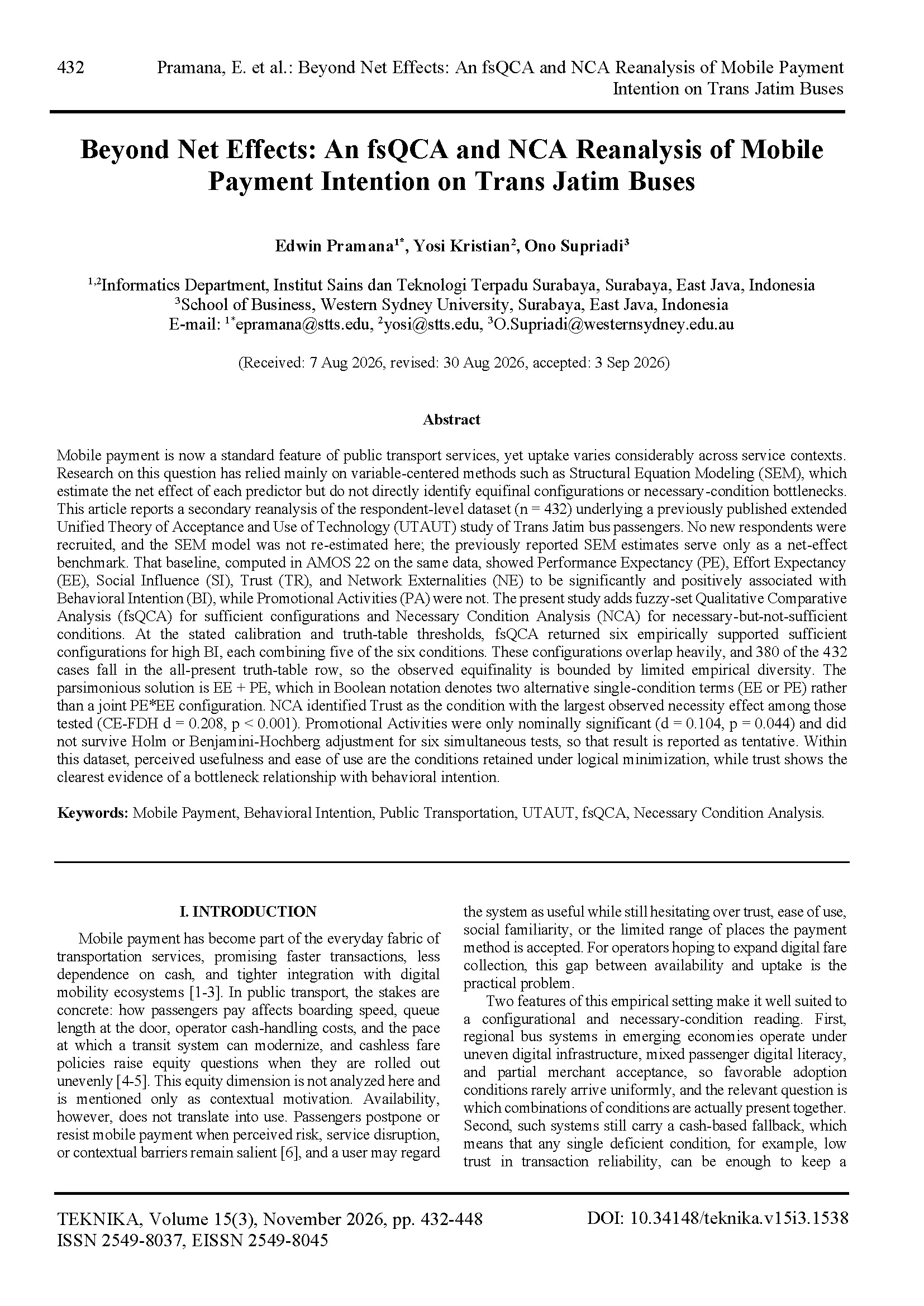
Mobile payment is now a standard feature of public transport services, yet uptake varies considerably across service contexts. Research on this question has relied mainly on variable-centered methods such as Structural Equation Modeling (SEM), which estimate the net effect of each predictor but do not directly identify equifinal configurations or necessary-condition bottlenecks. This article reports a secondary reanalysis of the respondent-level dataset (n = 432) underlying a previously published extended Unified Theory of Acceptance and Use of Technology (UTAUT) study of Trans Jatim bus passengers. No new respondents were recruited, and the SEM model was not re-estimated here; the previously reported SEM estimates serve only as a net-effect benchmark. That baseline, computed in AMOS 22 on the same data, showed Performance Expectancy (PE), Effort Expectancy (EE), Social Influence (SI), Trust (TR), and Network Externalities (NE) to be significantly and positively associated with Behavioral Intention (BI), while Promotional Activities (PA) were not. The present study adds fuzzy-set Qualitative Comparative Analysis (fsQCA) for sufficient configurations and Necessary Condition Analysis (NCA) for necessary-but-not-sufficient conditions. At the stated calibration and truth-table thresholds, fsQCA returned six empirically supported sufficient configurations for high BI, each combining five of the six conditions. These configurations overlap heavily, and 380 of the 432 cases fall in the all-present truth-table row, so the observed equifinality is bounded by limited empirical diversity. The parsimonious solution is EE + PE, which in Boolean notation denotes two alternative single-condition terms (EE or PE) rather than a joint PE*EE configuration. NCA identified Trust as the condition with the largest observed necessity effect among those tested (CE-FDH d = 0.208, p < 0.001). Promotional Activities were only nominally significant (d = 0.104, p = 0.044) and did not survive Holm or Benjamini-Hochberg adjustment for six simultaneous tests, so that result is reported as tentative. Within this dataset, perceived usefulness and ease of use are the conditions retained under logical minimization, while trust shows the clearest evidence of a bottleneck relationship with behavioral intention.
Downloads
References
[1] Balakrishnan V, Shuib NLM. Drivers and inhibitors for digital payment adoption using the Cashless Society Readiness-Adoption model in Malaysia. Technology in Society. 2021;65:101554. doi:10.1016/j.techsoc.2021.101554.
[2] Rahman M, Ismail I, Bahri S. Analysing consumer adoption of cashless payment in Malaysia. Digital Business. 2021;1(1):100004. doi:10.1016/j.digbus.2021.100004.
[3] Yang M, Al Mamun A, Mohiuddin M, Che Nawi N, Zainol NR. Cashless Transactions: A Study on Intention and Adoption of e-Wallets. Sustainability. 2021;13(2):831. doi:10.3390/su13020831.
[4] Golub A, Brown A, Brakewood C, MacArthur J, Lee S, Ziedan A. Equity and exclusion issues in cashless fare payment systems for public transportation. Transportation Research Interdisciplinary Perspectives. 2022;15:100628. doi:10.1016/j.trip.2022.100628.
[5] Azmoodeh M, Sheykhfard A, Tabatabaei F, Azimi M, Guo QV, Soltani N. Modeling Barriers to Cashless Fare Adoption in U.S. Public Transit Systems. Transportation Research Record: Journal of the Transportation Research Board. 2026. doi:10.1177/03611981261431737.
[6] Khanra S, Dhir A, Kaur P, Joseph RP. Factors influencing the adoption postponement of mobile payment services in the hospitality sector during a pandemic. Journal of Hospitality and Tourism Management. 2021;46:26-39. doi:10.1016/j.jhtm.2020.11.004.
[7] Venkatesh V, Morris MG, Davis GB, Davis FD. User acceptance of information technology: Toward a unified view. MIS Quarterly. 2003;27(3):425-478. doi:10.2307/30036540.
[8] Venkatesh V, Thong JYL, Xu X. Consumer acceptance and use of information technology: Extending the Unified Theory of Acceptance and Use of Technology. MIS Quarterly. 2012;36(1):157-178. doi:10.2307/41410412.
[9] Patil P, Tamilmani K, Rana NP, Raghavan V. Understanding consumer adoption of mobile payment in India: Extending Meta-UTAUT model with personal innovativeness, anxiety, trust, and grievance redressal. International Journal of Information Management. 2020;54:102144. doi:10.1016/j.ijinfomgt.2020.102144.
[10] Widyanto HA, Kusumawardani KA, Yohanes H. Safety first: extending UTAUT to better predict mobile payment adoption by incorporating perceived security, perceived risk and trust. Journal of Science and Technology Policy Management. 2022;13(4):952-973. doi:10.1108/JSTPM-03-2020-0058.
[11] Singh S. An integrated model combining ECM and UTAUT to explain users' post-adoption behaviour towards mobile payment systems. Australasian Journal of Information Systems. 2020;24. doi:10.3127/ajis.v24i0.2695.
[12] Srivastava S, Shunmugasundaram V. Mobile payment FinTech services adoption: comparing three models. Management Decision. 2025 (online first):1-29. doi:10.1108/MD-02-2025-0338.
[13] Motwani K, Choubey S, Saxena A, Patni I. Generation Z's mobile payment adoption: integrating UTAUT model and government initiative impacts. Journal of Innovation and Entrepreneurship. 2026;15(1). doi:10.1186/s13731-026-00658-1.
[14] Kharismawan R, Pramana E, Kristian Y. Factors Influencing Mobile Payment Adoption Utilizing Extended UTAUT with a Case Study: Public Transportation Trans Jatim Buses. Jurnal Teknologi dan Manajemen Informatika. 2025;11(1):69-80. doi:10.26905/jtmi.v11i1.15649.
[15] Ghosh A, Mishra R, Mishra A. Role of network externalities and trust facilitators in shaping mobile payment application continuance intentions: variations across stages of adoption. Marketing Intelligence & Planning. 2025;43(8):1553-1575. doi:10.1108/MIP-06-2024-0417.
[16] Ajao QM, Oludamilare O, Sadeeq L. Drivers of Mobile Payment Acceptance: The Impact of Network Externalities in Nigeria. OALib. 2023;10(06):1-19. doi:10.4236/oalib.1110240.
[17] Zheng W, Qiu H, Morrison AM. Applying a combination of SEM and fsQCA to predict tourist resource-saving behavioral intentions in rural tourism: An extension of the theory of planned behavior. International Journal of Environmental Research and Public Health. 2023;20(2):1349. doi:10.3390/ijerph20021349.
[18] Dieu HTM, Al Mamun A, Nguyen TLH, Naznen F. Cashless Vietnam: a study on intention and adoption of cashless payment. Journal of Science and Technology Policy Management. 2025;16(2):344-364. doi:10.1108/JSTPM-02-2022-0031.
[19] Chen M, Wang H, Liang Y, Zhang G. Net and configurational effects of determinants on cloud computing adoption by SMEs under cloud promotion policy using PLS-SEM and fsQCA. Journal of Innovation & Knowledge. 2023;8(3):100388. doi:10.1016/j.jik.2023.100388.
[20] Hussain M, Begum Q, Rahman MS, Imran A. Application of SEM and fsQCA to predict m-health adoption in the BoP market. Digital Policy, Regulation and Governance. 2023;25(6):545-567. doi:10.1108/DPRG-02-2023-0024.
[21] Niu Z, Liu W, Yao J, Xiao X, Wu J. A multidimensional analysis of potential suppliers' behavioral intentions in shared parking: Insights from SEM, NCA, and fsQCA. Transport Policy. 2025;174:103861. doi:10.1016/j.tranpol.2025.103861.
[22] Ragin CC. Redesigning Social Inquiry: Fuzzy Sets and Beyond. Chicago: University of Chicago Press; 2008.
[23] Fiss PC. Building better causal theories: A fuzzy set approach to typologies in organization research. Academy of Management Journal. 2011;54(2):393-420. doi:10.5465/amj.2011.60263120.
[24] Mattke J, Maier C, Weitzel T, Thatcher JB. Qualitative comparative analysis in the information systems discipline: a literature review and methodological recommendations. Internet Research. 2021;31(5):1493-1517. doi: 10.1108/INTR-09-2020-0529.
[25] Rasoolimanesh SM, Valaei N, Rezaei S. Guideline for application of fuzzy-set Qualitative Comparative Analysis (fsQCA) in tourism and hospitality studies. In: Cutting Edge Research Methods in Hospitality and Tourism. Emerald Publishing Limited; 2023:137-156. doi:10.1108/978-1-80455-063-220231009.
[26] Dul J. Necessary Condition Analysis (NCA): Logic and methodology of 'necessary but not sufficient' causality. Organizational Research Methods. 2016;19(1):10-52. doi:10.1177/1094428115584005.
[27] Dul J, van der Laan E, Kuik R. A statistical significance test for Necessary Condition Analysis. Organizational Research Methods. 2020;23(2):385-395. doi:10.1177/1094428118795272.
[28] Vis B, Dul J. Analyzing relationships of necessity not just in kind but also in degree: Complementing fsQCA with NCA. Sociological Methods & Research. 2018;47(4):872-899. doi:10.1177/0049124115626176.
[29] Solaimani S, Swaak L. Critical Success Factors in a multi-stage adoption of Artificial Intelligence: A Necessary Condition Analysis. Journal of Engineering and Technology Management. 2023;69:101760. doi:10.1016/j.jengtecman.2023.101760.
[30] Eccarius T, Chen CF. Examining trust as a critical factor for the adoption of electric vehicle sharing via necessary condition analysis. Technological Forecasting and Social Change. 2024;208:123681. doi:10.1016/j.techfore.2024.123681.
[31] Rasoolimanesh SM. Applying fsQCA, NCA and NConfA in tourism research. Annals of Tourism Research. 2026;116:104069. doi:10.1016/j.annals.2025.104069.
[32] Schneider CQ, Wagemann C. Set-Theoretic Methods for the Social Sciences: A Guide to Qualitative Comparative Analysis. Cambridge: Cambridge University Press; 2012. doi:10.1017/CBO9781139004244.
[33] Greckhamer T, Furnari S, Fiss PC, Aguilera RV. Studying configurations with qualitative comparative analysis: Best practices in strategy and organization research. Strategic Organization. 2018;16(4):482-495. doi:10.1177/1476127018786487.
[34] Dul J. Conducting Necessary Condition Analysis for Business and Management Students. London: SAGE Publications; 2020.
[35] Dul J, Hauff S, Bouncken RB. Necessary condition analysis (NCA): review of research topics and guidelines for good practice. Review of Managerial Science. 2023;17(2):683-714. doi:10.1007/s11846-023-00628-x.
[36] Holm S. A simple sequentially rejective multiple test procedure. Scandinavian Journal of Statistics. 1979;6(2):65-70.
[37] Benjamini Y, Hochberg Y. Controlling the false discovery rate: a practical and powerful approach to multiple testing. Journal of the Royal Statistical Society: Series B. 1995;57(1):289-300. doi:10.1111/j.2517-6161.1995.tb02031.x.
[38] Liu Y, Meng Q. How online reviews of sports tourism affect tourists' value co-creation behavior: Findings from PLS-SEM, NCA, and fsQCA. Journal of Hospitality and Tourism Management. 2024;60:360-372. doi:10.1016/j.jhtm.2024.07.005.
[39] Yamin MAY, Abdalatif OAA. Examining consumer behavior towards adoption of quick response code mobile payment systems: transforming mobile payment in the fintech industry. Humanities and Social Sciences Communications. 2024;11(1). doi:10.1057/s41599-024-03189-w.
[40] Cao W, Chen Y, Wang K. What determines low-carbon travel? A policy-oriented assessment using PLS-SEM and NCA in an extended TPB framework. Transportation. 2026. doi:10.1007/s11116-026-10734-w.
Downloads
Published
Issue
Section
License
Copyright (c) 2026 Teknika

This work is licensed under a Creative Commons Attribution-ShareAlike 4.0 International License.